Why Your Pillow Is Causing Your Neck Pain (And How to Fix It Tonight)
Waking up with neck stiffness isn't normal. It means your pillow isn't supporting your cervical spine. Here's exactly what's going wrong and what to look for in a replacement.

By Emma Clarke
Key takeaways
- —Morning neck pain that fades within an hour is almost always caused by your pillow
- —Your cervical spine has a natural C-curve that needs support — most pillows flatten it
- —The wrong pillow height for your sleep position forces your neck muscles to compensate all night
The Test: Is Your Pillow the Problem?
Answer these questions:
- —Do you wake up with neck stiffness or pain most mornings?
- —Does the pain fade within 30-60 minutes of getting up?
- —Do you find yourself re-adjusting your pillow multiple times before falling asleep?
- —Is your pillow more than 18 months old?
If you answered yes to two or more, your pillow is almost certainly the cause.
What's Actually Happening to Your Neck
Your cervical spine has a natural C-shaped curve. When you're standing or sitting with good posture, the muscles in your neck are relaxed because the bones are stacked properly.
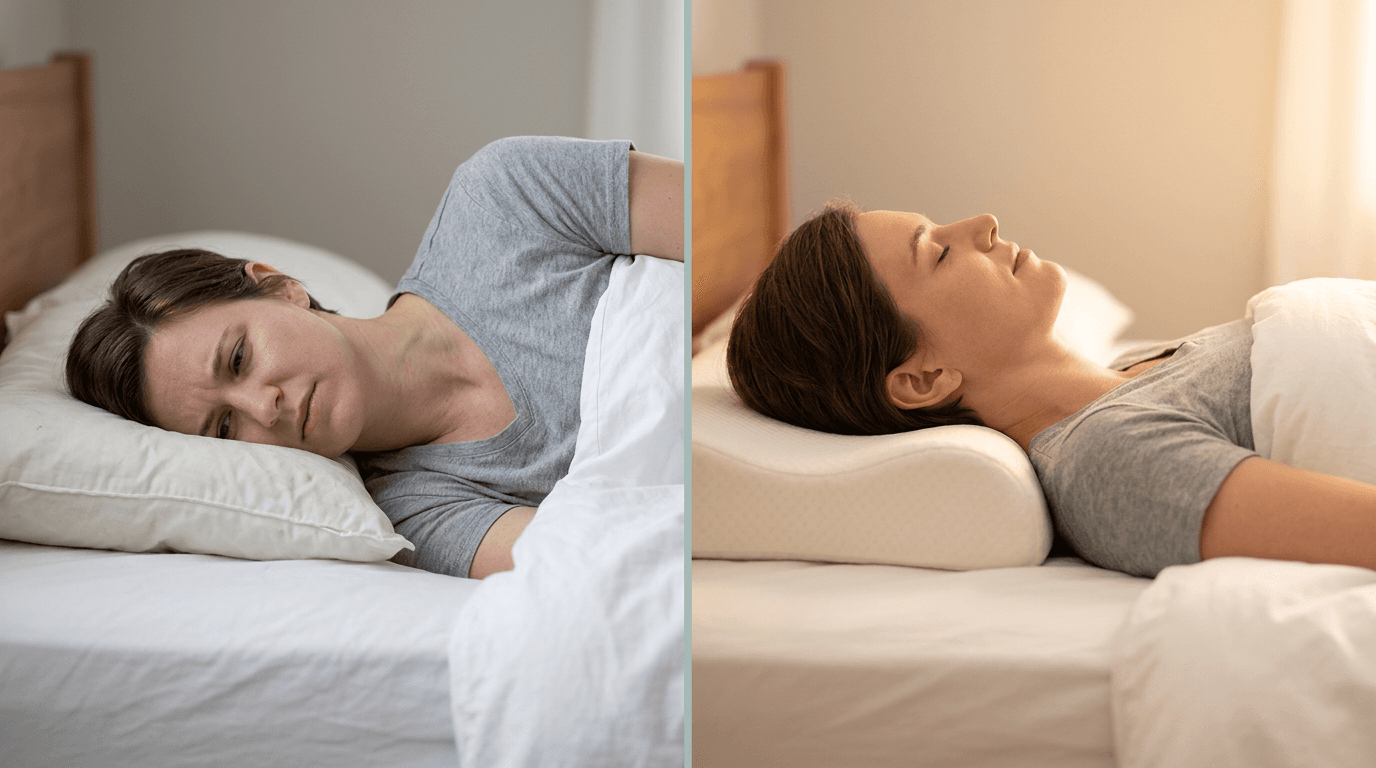
When you lie down on a pillow that's too flat, too high, or not contoured, that C-curve gets disrupted. Your neck either drops back (pillow too low), crunches forward (pillow too high), or tilts sideways (wrong loft for side sleeping).
In all three cases, your neck muscles engage to compensate. They tense up and hold that tension for 7-8 hours straight. That's why you wake up stiff — your muscles have been working overtime all night instead of resting.
Why Flat Pillows Fail
Standard pillows — whether they're polyester fill, down, or flat memory foam — have a uniform height across the entire surface. But your head and your neck need different amounts of support.
Your head is heavy (4-5 kg on average). It needs a supportive surface that it can sink into slightly. Your neck is a curved column of vertebrae that needs to be supported in its natural arc — not pressed flat.
A flat pillow can't do both. Either your head is at the right height and your neck is unsupported, or your neck has adequate filling beneath it and your head is pushed too high.
Why Most "Ergonomic" Pillows Still Fail
Walk through any bedding department and you'll see pillows with a gentle wave shape labelled "ergonomic." These are better than flat pillows, but they still have a fundamental problem: they're designed for one sleeping position.
A standard contour pillow with a higher front edge works reasonably well for back sleeping. But when you roll onto your side — which most people do multiple times per night — that same height isn't enough to fill the gap between your ear and shoulder. Your neck tilts, your muscles engage, and you're right back to square one.
The Fix: Multi-Zone Support
The only way to maintain cervical alignment in every sleeping position is a pillow with different zones for different positions. This is exactly what the butterfly contour design does.
The Sleepr has 5 support zones:
- —Rear wings that cradle your head at the right height for back sleeping
- —Front wings that provide the extra height needed when you're on your side
- —Shoulder cutouts that let your shoulder drop in instead of pushing your head up
- —A cervical core that actively supports your neck's C-curve
- —Arm channels for stomach sleepers who need a place for their arms
When you switch positions during the night, you naturally move to a different zone. Your neck stays aligned without you having to think about it.
Quick Fixes You Can Try Tonight
While you're deciding on a new pillow, these adjustments can help:
- If you're a side sleeper on a thin pillow: Fold a towel and place it under your pillowcase to add height
- If you're a back sleeper on a thick pillow: Remove extra filling or use a thinner pillow
- Avoid stacking two pillows: This almost always puts your neck at the wrong angle
- Test with a rolled towel: Place a small rolled towel inside your pillowcase at the bottom edge. If your neck pain improves, your pillow's cervical support is inadequate
The bottom line
Neck pain from sleeping isn't something you have to accept. It's a fixable problem with a clear cause: your pillow isn't supporting your cervical spine in the positions you actually sleep in. A pillow with multi-zone support — like The Sleepr butterfly contour — keeps your spine aligned whether you're on your back, side, or stomach. And with a 30-day trial, you don't have to guess whether it'll work.
4 min read